A story untold is a life not lived
The Drover's Wife“A story untold is a life not lived” names the novel’s insistence that telling is not merely a record of experience but a way of keeping people and histories present. Repeated across Yadaka’s inheritance of a forbidden story, Danny’s guarded memories, and his later family storytelling, the expression makes narration an act of survival and transmission.
The phrase as a principle of telling
Yadaka voices the thought while explaining that he is leaving to travel north along the eastern highlands toward his mother’s Country. Molly asks why he is telling her his life story; he answers, “A life’s story untold is a life not lived, missus.” The line prompts Molly to think of her father, whose view would have accorded with it, even as she resists Yadaka’s invitation to share her own story. Telling is offered as a means of recognition, not demanded as an immediate confession.
The wording returns with greater urgency when Yadaka tells Molly the story of her mother. Facing her shotgun and her anger, he pleads that the account is her truth and part of their lore, which must be shared if it is to endure. He identifies her mother by both names, Black Mary and Waraganj, and insists that she lived fully despite a short life. The repeated maxim thus links the act of telling to the continued presence of someone whose story has been suppressed or forbidden.
Inherited stories and guarded memories
The principle also shapes Yadaka’s own responsibility as a keeper of stories. After joining a community gathered for ceremony and the bogong moth feast, he is adopted by Ginny May and learns why she chose him: she has a story considered bad luck and forbidden to share within her clan. Adoption gives her a son to whom she can entrust it; Yadaka understands that he is now responsible for keeping it alive. Its fragments return to him out of chronological order, and he expects to seek guidance from the ancestors as he puts them together. The expression’s claim that an untold life is not lived therefore carries a practical burden: a story can survive only if someone receives and preserves it.
Danny’s notebook gives that burden a more private form. At thirty-two, he reads the sketches, poems, and memories he began recording sixteen years earlier, after the events that sent him and his siblings into the mountains. The notebook holds what he learned during four short years, including knowledge he knew could not be fully transmitted because time and society were against it. Louisa Clintoff had encouraged him to write poetry as a way to ease hurt and loss, without requiring him to share the poems. Danny nevertheless keeps the record, while continuing to protect his siblings from memories he has never even disclosed to them.
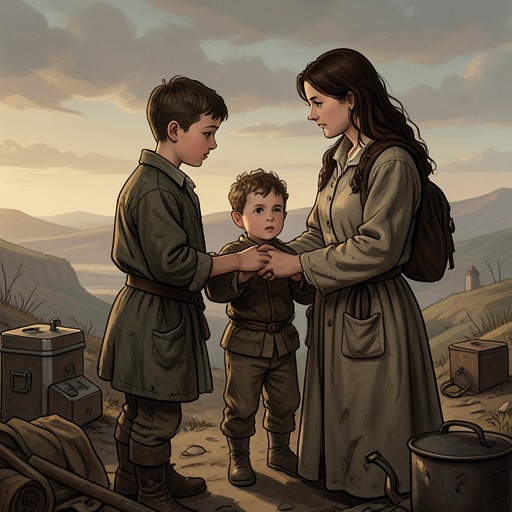
One such memory is of lying awake as a child, frightened by the sounds of his father beating his mother. Through a crack by the door, he sees Molly curled on the ground as Joe strikes her. Danny remembers being unable to intervene: on an earlier occasion Joe had thrown him so hard that he hit his head and was sick for days, and Molly now bears the blows quietly to keep her son from being drawn into the violence. When Nate asks what Danny heard on a night like that, the memory floods back, but Danny hides its force behind the reply that it was the usual. The contrast between the vivid memory and his evasive answer shows why the notebook matters: some experiences are preserved before they can be spoken aloud.
From private record to family inheritance
Years later, Danny’s account becomes a story told and retold within his own household. He sits with his pregnant Aboriginal wife, Nell, and their six children, whose ages range from two to twelve and whose complexions and features recall their great-grandmother, Waraganj. Danny says the story is the one he lived and has told, and that he will pass it on as a story of survival. The act of transmission now reaches beyond his notebook and beyond the siblings he once tried to shield.
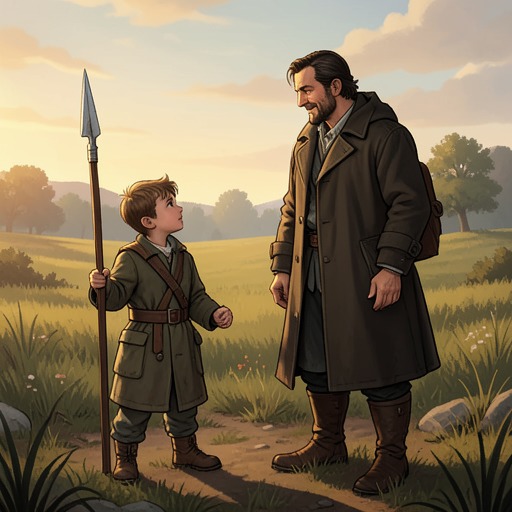
Storytelling in the family is both spoken and enacted. Each evening, the children hear stories from Danny or Nell; they also perform stories they know, including the Bullock Story, honoring the legend of their grandmother Molly. Danny takes pleasure in recounting how Yadaka acted out the bullock, though a momentary sadness crosses his face, noticed only by Nell. The story continues as a shared family practice, but its retelling does not erase the grief embedded in it.
Narrative significance
The expression gathers together distinct forms of memory without making them identical. Yadaka receives a story that his adoptive mother could not tell within her clan; Danny privately records experiences he cannot yet reveal; and, as an adult, he makes family history available to his children through narration and reenactment. Across these shifts, a story changes audience and form while carrying knowledge that might otherwise be lost.
The phrase’s force lies in that movement from silence toward inheritance. It does not mean that every painful memory is immediately spoken: Danny’s reticence and Molly’s refusal show the limits and risks of disclosure. Rather, the novel presents telling, preserving, and retelling as ways of resisting disappearance. A life becomes part of the future not because its wounds are resolved, but because someone keeps its story alive.